


Views: 0 Author: Site Editor Publish Time: 2026-10-19 Origin: Site


Selecting the right takeout containers for a commercial kitchen goes far beyond basic aesthetics today. Global mandates are rapidly phasing out single-use plastics, forcing foodservice operators to pivot toward sustainable alternatives quickly. Local regulators are strictly enforcing bans on traditional materials, making immediate compliance highly necessary.
However, blindly adopting any eco-friendly material often leads to severe operational headaches. Managers frequently face compromised food quality, unexpected leaks, rapid heat loss, and significantly blown budgets when materials fail in transit. The stakes are high, and relying solely on green marketing claims is a costly mistake.
This guide provides a clear, unbiased evaluation of bagasse, cornstarch, and rice husk materials. You will learn how to match the ideal option to your specific menu items and delivery models. Ultimately, you can confidently navigate the complex sustainable packaging market without sacrificing performance or customer satisfaction.
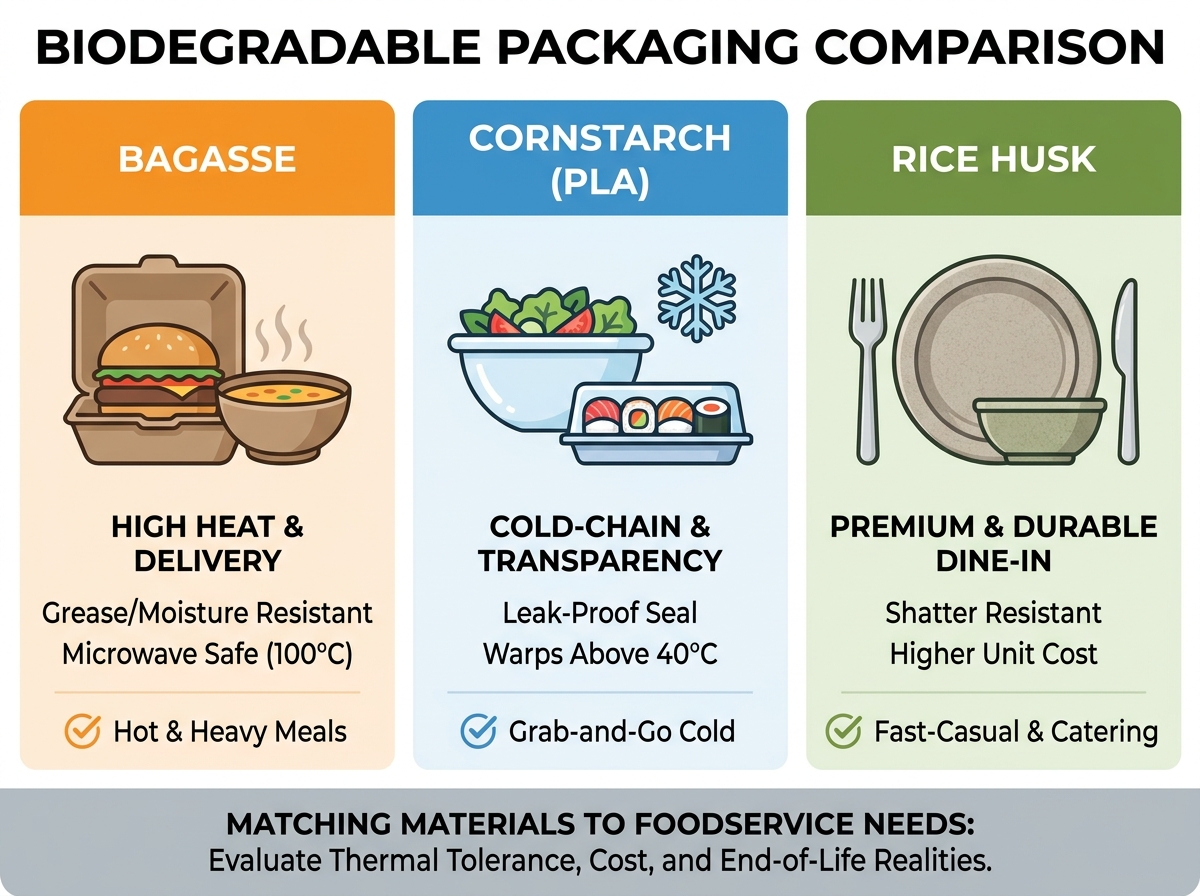
Bagasse is the optimal choice for hot, heavy, or greasy delivery foods due to its thermal tolerance and structural integrity.
Cornstarch (PLA) excels in cold-chain and grab-and-go scenarios where transparency and a plastic-like feel are required, but fails under high heat.
Rice husk serves as a premium, highly durable option best suited for fast-casual dine-in or multi-use models, though it carries a higher unit cost.
Evaluating biodegradable food packaging requires looking beyond marketing claims to verify commercial compostability standards and specific storage/shelf-life limitations.
The food industry faces a massive compliance shift. Local and federal governments are aggressively banning expanded polystyrene (EPS) foam across major metropolitan areas. They are also strictly regulating PFAS chemicals traditionally used in food contact materials. This regulatory pressure makes transitioning to biodegradable food packaging mandatory rather than optional. Yet, procurement managers must evaluate these materials rigorously before signing contracts.
To avoid operational disasters, you must define baseline metrics for B2B procurement. Success requires looking past superficial sustainability claims and focusing on hard performance data. Consider the following operational success criteria:
Thermal and Moisture Resistance: Can the container hold liquids exceeding 85°C without structural failure or collapsing during a 30-minute commute?
Unit Economics versus Perceived Value: You must balance the cost per unit against customer willingness to pay for sustainable branding. Premium materials only make sense if your pricing model supports them.
End-of-Life Realities: You need to understand the critical difference between items labeled "backyard compostable" and those requiring industrial composting facilities. Misleading customers about disposal methods harms brand trust.
When searching for a robust solution, bagasse food packaging frequently emerges as the most reliable option for demanding menus. Manufacturers create this material using upcycled sugarcane fiber, which is a direct byproduct of the sugar extraction industry. Instead of burning this agricultural waste, facilities pulp it and mold it into sturdy containers.
Bagasse offers exceptional performance strengths for hot food applications:
High heat resistance makes it fully microwave safe and capable of withstanding temperatures up to 100°C (212°F).
It provides excellent grease and moisture retention, proving essential for heavy sauces, curries, and fried foods.
The material will not melt or leach toxic chemicals when exposed to boiling hot food.
However, applying a skeptic's lens reveals a few operational limitations. Bagasse possesses high breathability. This characteristic leads to "sweating" inside the container. Hot, crispy foods may lose texture and become soggy if you do not use vented lids. Furthermore, PFAS compliance remains a critical checkpoint. Historically, manufacturers relied on added PFAS chemicals to achieve grease resistance in molded fibers. Today, buyers must explicitly verify "PFAS-free" or "fluorine-free" certifications to meet modern safety standards.
Ultimately, bagasse serves as the perfect match for burger boxes, hot curry or soup bowls, and heavy delivery meals requiring maximum structural support.
For operators managing cold chains and retail displays, Polylactic Acid (PLA) stands out. Manufacturers derive this bioplastic from fermented plant starch, most commonly corn. It physically mimics traditional petroleum-based plastics, making it an easy aesthetic transition for consumers.
The performance strengths of PLA directly benefit retail environments:
Exceptional visual clarity mirrors traditional PET plastic, proving crucial for merchandising colorful foods.
It delivers superior leak-proof sealing, securing thin liquids, dressings, and marinades flawlessly.
Consumers appreciate the smooth, premium tactile feel.
Despite these benefits, PLA carries significant operational limitations. Its low thermal threshold is the most prominent flaw. The material begins to warp, melt, and deform at temperatures above 40°C (105°F). This creates major storage risks. You must store PLA in climate-controlled warehouses. Shipping this material in non-refrigerated containers during summer months frequently results in melted, unusable inventory.
Additionally, PLA presents a strict disposal bottleneck. It requires commercial composting facilities reaching specific high temperatures to break down properly, governed by standards like ASTM D6400 or EN 13432. It will not degrade in standard municipal landfills or home compost bins.
Cornstarch PLA remains best suited for sushi trays, salad bowls, cold pressed juices, and grab-and-go deli items requiring maximum visibility.
Brands looking to elevate their presentation are increasingly turning to rice husk packaging. This material originates from the agricultural waste generated during rice milling. Manufacturers bind the crushed husks using natural resins or minimal biopolymers to create incredibly dense containers.
Rice husk brings unique performance strengths to the table:
It offers exceptional rigidity and shatter resistance, easily outperforming standard paperboards.
The distinctive, earthy aesthetic immediately elevates brand perception, signaling a premium dining experience.
It possesses enough durability to bridge the gap between single-use containers and limited multi-use models.
Operators must, however, weigh several limitations. This material commands a higher unit cost compared to standard bagasse and PLA alternatives. The dense composition also results in a heavier weight per unit. This extra weight can marginally increase shipping costs at scale. Furthermore, supplier availability remains spotty. Procurement teams often face steep Minimum Order Quantity (MOQ) constraints, making it difficult for smaller brands to secure inventory.
Rice husk works best for premium fast-casual dine-in settings, high-end corporate catering, and eco-conscious brands wanting a bespoke, artisanal presentation.
Selecting the correct material requires aligning physical container limits with your specific culinary outputs. Use the framework below to drive your shortlisting process.
Menu Scenario | Bagasse | Cornstarch (PLA) | Rice Husk |
|---|---|---|---|
Hot Delivery & Takeout | Winner: Retains heat, prevents melting. | Fail: Warps and melts above 40°C. | Pass: Strong, but carries high unit costs. |
Cold Grab-and-Go (Retail) | Pass: Functional but lacks item visibility. | Winner: Clear visibility drives impulse sales. | Pass: Premium feel, but hides the food. |
Sauce-Heavy / Soups | Winner: Excellent absorption resistance (needs right lid). | Pass: Perfect seal, but strictly for cold liquids. | Winner: High structural integrity prevents collapsing. |
Cost-to-Scale for Small Brands | Winner: Low MOQs and standardized market pricing. | Pass: Moderate pricing, requires climate logistics. | Fail: High MOQs and expensive base costs. |
Even after selecting the right material, procurement teams face several hidden implementation risks. Navigating supplier relationships requires knowing exactly which questions to ask.
Greenwashing pitfalls are everywhere. Many suppliers stamp "eco-friendly" or "green" on boxes without holding actual certifications. To verify claims, you must look for official BPI (Biodegradable Products Institute) or OK Compost certifications. Without these third-party verifications, you risk buying green-tinted traditional plastics.
Supply chain and shelf life limitations catch many operators off guard. Biodegradable materials possess a literal shelf life. Over-ordering to hit a supplier's MOQ seems smart financially, but it often leads to disaster. If you store fiber-based inventory in a dry warehouse for over 12 months, the material becomes brittle. Containers will literally snap in your staff's hands during service.
Lid compatibility issues represent the most common failure point. Many brands pair a fiber base with a clear PLA lid. Procurement teams must account for thermal expansion and contraction. When you put hot food in a fiber bowl, the bowl expands slightly. The cold PLA lid, however, does not. This mismatch breaks the seal, causing lids to pop off during delivery commutes.
Before signing any annual contract, take action by running a practical stress test. Request sample packs from multiple suppliers. Conduct a strict "45-minute delivery simulation test." Plate your hottest, greasiest menu item, seal the container, place it in an insulated delivery bag, and drive it around for 45 minutes. Evaluate the temperature retention, structural integrity, and lid security upon your return.
There is no universal "best" sustainable container. You will only find the right material for your specific menu physics and supply chain realities. Transitioning to sustainable alternatives requires treating your packaging as a functional ingredient rather than just a passive vessel. Follow these actionable next steps to secure the right fit:
Audit your current packaging failures by tracking customer complaints regarding leaks, cold food, or crushed boxes.
Calculate your maximum allowable unit cost before exploring premium materials like rice husk.
Always verify PFAS-free and commercial compostability certifications before placing bulk orders.
Demand sample packs and run rigorous 45-minute delivery simulations using your actual menu items.
A: Yes, it is highly heat resistant and perfectly safe for microwaves. The dense sugarcane fibers withstand high temperatures without releasing toxins, unlike PLA or cornstarch options which will quickly melt and deform under microwave radiation.
A: Rarely. While some unlined fiber options are home-compostable, materials like cornstarch (PLA) strictly require industrial composting facilities. These commercial plants reach the sustained high temperatures necessary to break down bioplastics effectively.
A: Both are high-strength agricultural byproducts. However, rice husk often provides a denser, more rigid structure suitable for heavier, premium meals. Bamboo currently benefits from wider supplier availability and lower MOQs, making it slightly easier to source.
A: Historically, manufacturers used PFAS in molded fibers to guarantee grease resistance. Regulations have changed rapidly. Buyers must now explicitly request "PFAS-free" or "fluorine-free" certified products from their suppliers to ensure compliance with modern safety laws.


