


Views: 0 Author: Site Editor Publish Time: 2026-10-25 Origin: Site


Bundling food products into retail-ready multipacks introduces a tension between packaging cost, structural integrity, and shelf presentation. You must balance visual appeal against the physical rigors of distribution. Retailers demand pristine conditions upon arrival, expecting zero damage during transit.
While both polyolefin (POF) and standard cling wraps are ubiquitous in food packaging, their physical properties dictate completely different operational workflows and end-use applications. Choosing poorly often leads to damaged goods or compromised food hygiene. Operations managers face intense pressure to optimize these wrapping processes daily.
Selecting the correct material requires evaluating not just the unit cost of the plastic, but equipment capital, tamper-evidence requirements, and thermal sensitivity of the packaged food. We will explore the precise mechanics behind these two formats. You will learn how to match your production line to the right film technology.
POF heat shrink film offers superior structural rigidity and tamper evidence, making it the industry standard for retail-facing multipacks.
Food service cling film is ideal for short-term, manual bundling or fresh produce that requires high breathability, but lacks the tensile strength for heavy transport.
The primary implementation barrier for POF is the required capital investment in heat sealing and shrink tunnel machinery.
Regulatory compliance (e.g., direct vs. indirect FDA food contact approval) dictates material selection based on whether the film touches the food or just the primary packaging.
Understanding how secondary packaging secures food items requires looking at molecular behavior. The two plastics operate under completely different physical principles. One uses thermal energy to change shape. The other relies on physical stretching and surface tension.
Polyolefin behaves uniquely under heat due to its biaxially oriented structure. Manufacturers stretch the plastic film in two directions during production. This aligns the cross-linked polymer chains tightly. The material remains stable at room temperature. However, it reacts dramatically when you introduce thermal energy.
When you pass a wrapped multipack through a controlled heat source, the polymer chains relax. They contract forcefully around the contents. This creates a rigid, uniform secondary package. It acts like a second skin. Heat shrink film locks loose items together instantly. The resulting bundle resists shifting, preventing internal friction during transit.
Standard wrap materials take a mechanical approach. These films typically consist of polyethylene (PE) or polyvinyl chloride (PVC). They rely heavily on mechanical stretch rather than thermal contraction. Operators or automated wrappers pull the material tightly around a tray.
The plastic exhibits strong electrostatic properties. It generates a static charge when unwound from the roll. The film aggressively adheres to itself and to smooth surfaces. It relies on constant tension to hold multipacks together. Unlike thermal wraps, it never fundamentally changes its physical dimensions. It simply stretches and grips.
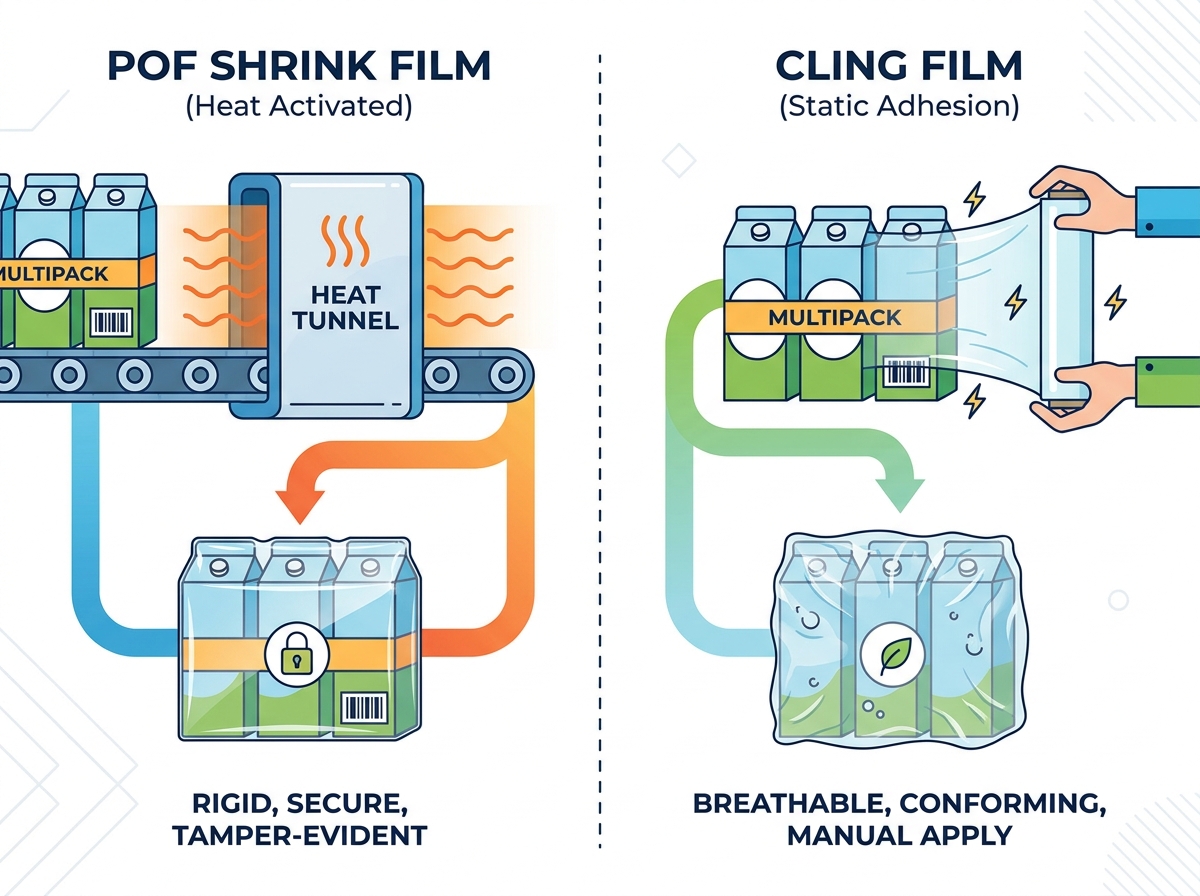
Retailers expect flawless presentation on store shelves. The structural demands on commercial multipacks increase every year. Choosing POF shrink film solves many logistical headaches. It transforms loose bottles or boxes into singular, highly durable retail units.
Visual appeal drives consumer purchasing decisions. Polyolefin delivers exceptional high gloss and optical clarity. This transparency proves essential for retail operations. Barcodes printed on primary packaging remain perfectly scannable through the outer layer. Shoppers can clearly read nutritional labels and branding. The material never fogs or yellows under fluorescent store lighting.
Food and beverage multipacks require strict safety protocols. Once shrunk over a product, polyolefin cannot be removed without obvious destruction. It will not stretch back into place. You cannot reapply it cleanly. This irreversible nature provides instant tamper evidence. Consumers trust packages they know remain unopened from the factory.
Heavy bundles test the limits of secondary packaging. Consider a three-pack of glass sauce jars or rigid juice cartons. Polyolefin possesses immense tensile strength. It grips irregularly shaped items tightly together. The bundle will not sag during long-haul transit. Puncture resistance ensures sharp carton corners do not tear the outer wrapping.
This method does present specific challenges on the factory floor. It requires precise temperature control.
Setting heat tunnels too high will burn the plastic.
Slow line speeds can melt heat-sensitive primary packaging.
Poorly calibrated seal bars leave unsightly "dog ears" on corners.
The process demands skilled operators for continuous monitoring.
Not every application requires rigorous thermal sealing. Many back-of-house and short-term retail scenarios demand flexibility over rigid strength. Hand-applied wraps serve a crucial purpose in modern grocery and culinary environments. They excel where rigid plastics typically fail.
Fresh foods respire continuously after harvesting. Produce multipacks release moisture and gases. Sealing them tightly accelerates spoilage. Food service cling film breathes naturally. It allows trapped condensation to escape. This moisture control keeps mushrooms crisp and prevents mold on fresh berries.
Capital expenditure often dictates packaging decisions for smaller businesses. Static-cling options require minimal to zero equipment investment. You can apply them manually using simple hand-wrapping stations. A basic slide-cutter dispenser costs almost nothing. This allows small-scale producers to bundle items immediately without financing heavy machinery.
Product dimensions change rapidly in fresh food environments. A butcher might wrap a small steak one minute and a large roast the next. Electrostatic films adapt instantly. They conform highly to variable shapes. You never need to adjust machine settings or wait for heat tunnels to warm up.
Despite their flexibility, these wraps fail in demanding supply chains.
They offer poor shelf-life extension for dry goods.
They provide zero tamper evidence, as they easily unwrap.
They demonstrate inadequate load retention for heavy retail bundles.
They easily puncture when stretched over sharp edges.
Below is a visual summary chart defining when to select each material.
Material Application Decision Matrix
Packaging Requirement | Recommended Material | Primary Reason |
|---|---|---|
Heavy multipack transit | Polyolefin (POF) | Superior tensile strength prevents sagging. |
Fresh produce bundling | Static Cling Wrap | Breathability stops rapid moisture rot. |
High-speed automated lines | Polyolefin (POF) | Scales to thousands of units per hour safely. |
Manual back-of-house prep | Static Cling Wrap | Requires zero machine heating or calibration. |
Transitioning between material types requires a methodical assessment. Factory managers must weigh regulatory rules against mechanical capabilities. You cannot base this decision on plastic thickness alone. We must evaluate three specific operational pillars.
Food safety regulations rigorously control packaging materials. You must differentiate between direct and indirect food contact ratings. Some films safely touch bare food. Others must only touch primary packaging.
Ensure your chosen polyolefin or stretch wrap carries correct certifications. High-fat foods actively pull chemical components from certain plastics. The FDA mandates specific migration limits. Verify these compliance certificates with your supplier before any direct contact occurs.
Speed dictates factory profitability. Different materials limit your ultimate throughput capacity.
Heat Shrink Lines: These automated systems require L-bar sealers or flow wrappers. You must pair them with convection shrink tunnels. This demands high initial capital expenditure. However, the investment scales beautifully. You can process thousands of units per hour with minimal labor.
Cling Wrapping: These operations remain limited to lower throughput. Manual hand-wrapping stations slow down output. Specific stretch-wrapping machinery exists, but it limits scalability for high-volume retail multipacks. It works best for low-volume, highly variable batches.
Sustainability mandates increasingly shape packaging choices. Polyolefin generally rates as 100% recyclable. Facilities classify it as LDPE #4. This aligns perfectly with major retail sustainability programs.
Conversely, certain PVC-based stretch films face increasing regulatory scrutiny. Environmental groups push for PVC bans. Disposal restrictions limit where you can send PVC waste. Transitioning away from PVC often improves your corporate environmental profile.
We can compare the technical properties of both formats to guide engineering decisions.
Technical Properties Comparison
Property | Polyolefin (POF) | Standard Cling Wrap (PE/PVC) |
|---|---|---|
Application Method | Thermal contraction | Mechanical stretch |
Tamper Evidence | High (Destructible) | None (Re-wrappable) |
Optical Clarity | Excellent / High Gloss | Moderate / Slight Haze |
Breathability | Very Low | High (Ideal for produce) |
Equipment Dependency | High (Sealers & Tunnels) | Low (Hand dispensers) |
Installing new packaging lines introduces immediate friction. Theory differs vastly from factory floor reality. Engineers must anticipate thermal dynamics and space constraints before committing to a rollout.
You must actively assess the heat threshold of your food product. Shrink tunnels operate at temperatures exceeding 300°F (150°C). Air circulates rapidly to activate the plastic.
Chocolate, dairy, or thin-walled primary plastics often struggle here. They may warp, bloom, or melt entirely inside the chamber. Line speeds and temperatures must be perfectly calibrated. Moving packages faster reduces heat exposure time. Thinner gauge plastics require less thermal energy to activate.
Space acts as a premium asset in manufacturing facilities. Industrial heat tunnel lines require significant floor space. You must plan for conveyor in-feeds and out-feeds. Furthermore, these machines require dedicated ventilation. They generate ambient heat.
Modular hand-wrapping stations avoid this problem entirely. You can mount them on walls or tuck them into tight prep corners. They draw no heavy electrical current.
Complex machinery demands rigorous maintenance schedules. Ignore this, and package quality plummets immediately.
Heat seal blades require regular Teflon tape replacement. Burnt plastic residue builds up quickly. You must clean blades daily to ensure hermetic seals. Tunnels require continuous calibration. Ambient plant temperatures change between summer and winter. You must adjust tunnel baffles accordingly to maintain consistent aesthetic results.
Choosing your packaging format shapes your entire downstream supply chain. It dictates how products survive transit and how consumers perceive them on shelves. Operations teams must base decisions on hard data rather than assumption.
Opt for breathable static wraps if bundling fresh, highly perishable goods in short-run operations.
Transition to rigid thermal polyolefin when scaling up for permanent retail distribution.
Prioritize aesthetics, barcode readability, and tamper evidence for consumer-facing goods.
Conduct a small-scale sample run with varying film thicknesses (e.g., 45-gauge vs. 60-gauge) before committing.
Test multipack rigidity and tunnel compatibility thoroughly on active factory lines.
A: Yes, many cross-linked POF films are FDA-approved for direct food contact, but manufacturers must verify the specific certification with their supplier, especially for high-fat foods.
A: It protects against dust, moisture, and handling, which preserves primary packaging integrity. However, it is not a hermetic seal and does not replace modified atmosphere packaging (MAP) for shelf-life extension.
A: Warping of primary packaging usually indicates the shrink tunnel temperature is too high, the line speed is too slow, or the film gauge is too heavy for the structural strength of the bundled items.
A: While historically common, many facilities are transitioning away from PVC to PE-based cling films or POF shrink films due to environmental regulations and the corrosive nature of PVC degradation on packaging machinery.


