


Views: 0 Author: Site Editor Publish Time: 2026-10-13 Origin: Site


Selecting the right plastic food trays goes far beyond simple unit cost calculations. The packaging material must align perfectly with your specific food applications to ensure product safety and consumer appeal. Misaligning material properties often leads to disastrous operational outcomes. You might see warped containers during hot-filling processes, cracked packaging during cold transit, or compromised top seals. These failures harm brand reputation and generate unnecessary waste.
Polyethylene Terephthalate (PET) and Polypropylene (PP) currently dominate the market. However, they serve entirely opposite thermal and aesthetic needs. This article provides packaging engineers and food manufacturers an evidence-based framework. You will learn how to evaluate both materials based on thermal limits, optical clarity, barrier performance, and sustainability mandates. We aim to help you make informed specification choices.
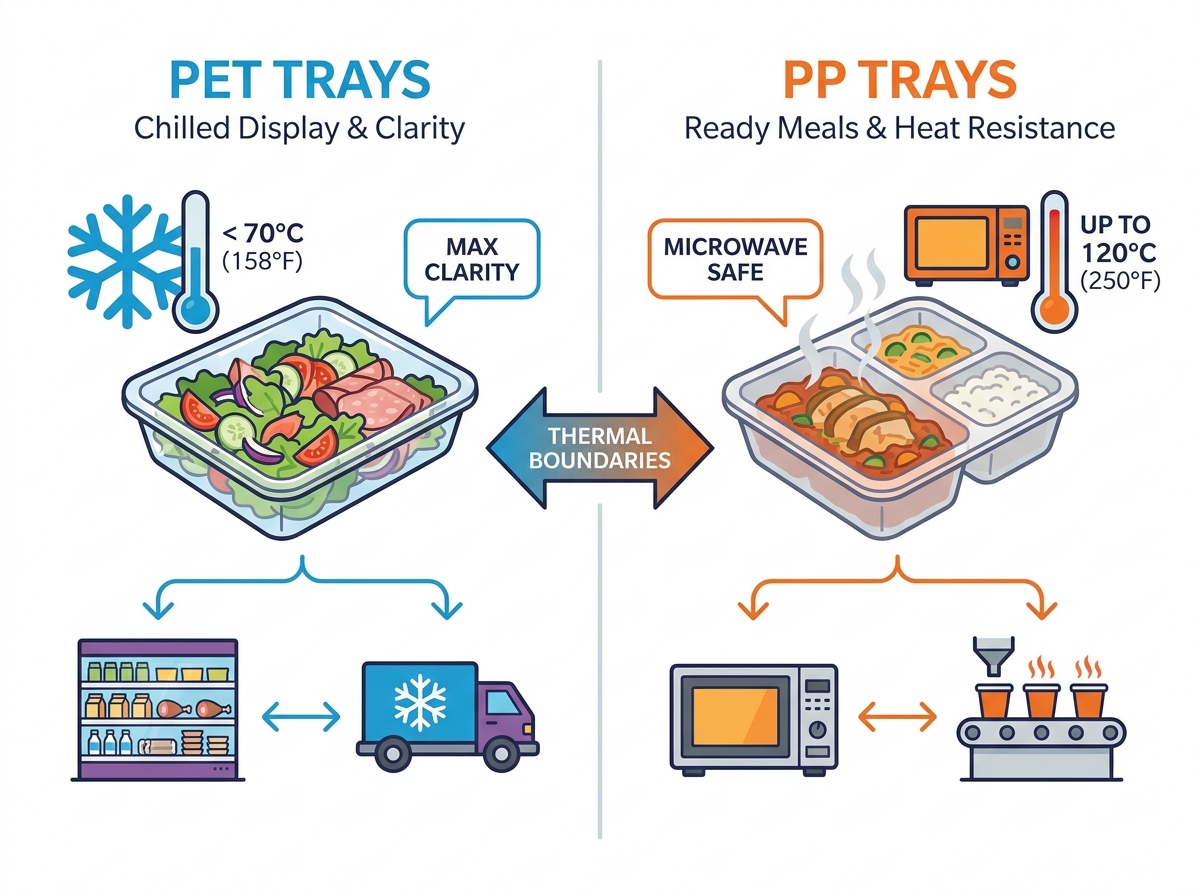
PET trays provide glass-like clarity and high cold-impact resistance, making them the standard for chilled displays (salads, deli meats, cold produce).
PP trays withstand temperatures up to 120°C (250°F), making them strictly necessary for microwaveable ready meals and hot-fill applications.
Sealing Compatibility: Switching between PET and PP requires top-film adjustments; universal films exist but may compromise hermetic seal integrity.
Compliance Reality: Both materials are recyclable, but PET currently benefits from a more established closed-loop recycling infrastructure (rPET) in many regional markets.
Packaging specification dictates how a product performs across the entire supply chain. Defining success requires looking at the product journey holistically. The right tray must protect the product from the packing facility to the consumer table. It must maintain strict visual merchandising standards on retail shelves. Furthermore, the material choice must meet local Extended Producer Responsibility (EPR) requirements. Regulatory bodies increasingly scrutinize packaging waste, forcing brands to justify their material selections.
The cost of failure in this space is substantial. Specifying PET for a microwaveable product risks material melting. In severe cases, it causes chemical leaching into the food. Conversely, using PP for premium chilled foods degrades visual appeal. PP has an inherent haziness. Shoppers often bypass cloudy packaging when inspecting fresh salads or cut fruit. They prefer high transparency to verify freshness.
Buyers must weigh several factors against each other. Temperature tolerance competes against optical clarity. Oxygen barriers compete against moisture barriers. Thermoforming behavior differs wildly between resin types. You must audit exactly how consumers interact with your product. A cold-chain pasta salad demands entirely different structural properties than a microwaveable lasagna.
Best Practice: Always map the "thermal journey" of your product. Document the maximum filling temperature, the minimum storage temperature, and the expected consumer preparation temperature before requesting material samples.
Polyethylene Terephthalate offers a highly distinct material profile. It is a high-density, rigid plastic known for being exceptionally clear. Packaging engineers specify this material when product visibility drives purchasing decisions. It feels sturdy in the hand and mimics the premium look of glass.
Ideal scenarios for PET trays revolve heavily around the cold chain. They excel at packaging cold cuts, fresh cut fruit, sushi, bakery items, and deli salads. Retailers prefer them for grab-and-go refrigerated sections.
The performance advantages are significant:
Superior visual merchandising: The glass-like transparency allows consumers to meticulously inspect food quality, color, and freshness.
Strong oxygen barrier: PET blocks oxygen transmission efficiently. This extends the shelf life of oxidation-sensitive foods like red meats and pre-cut apples.
Excellent cold resistance: These containers perform beautifully in freezing and cold storage environments. They resist becoming brittle or shattering upon impact.
Despite these strengths, operational limitations exist. PET has a famously low heat deflection temperature (HDT). The material will warp, shrink, and deform if exposed to temperatures above 70°C (158°F). You cannot microwave it. Hot-filling soups or sauces into these containers will cause immediate structural failure on the production line.
Common Mistake: Relying on standard PET for items stored under heat lamps. Even ambient display cases under strong incandescent lighting can occasionally push surface temperatures close to PET's deformation threshold.
Polypropylene steps in exactly where PET fails. Its material profile features a tough, highly flexible structure. It possesses a much higher melting point. Aesthetically, it carries a naturally translucent or milky finish. You cannot see through standard PP with the same pristine clarity as PET.
The industry relies on PP trays for demanding thermal applications. Ideal scenarios include microwaveable ready meals, hot takeout containers, soups, and heavy-duty meat packing. It is the undisputed champion of the hot-deli counter.
The performance advantages directly address thermal stress:
Extreme heat resistance: It remains structurally stable up to 120°C (250°F). It is fully microwave-safe for consumer reheating.
High moisture barrier: PP boasts an excellent Moisture Vapor Transmission Rate (MVTR). It prevents dehydration of cooked foods, locking steam and moisture inside.
Superior fatigue resistance: The material is highly flexible. Hinged containers made of PP can bend repeatedly. They will not snap or break during transit.
The primary operational limitation is its lower optical clarity. You can source "clarified PP" formulated with special additives to improve transparency. However, it still falls short of PET's glass-like transparency. Clarified versions also cost a premium. They can negatively impact your unit economics for low-margin food items. Furthermore, PP lacks the robust oxygen barrier found in PET, making it less ideal for long-term raw meat storage unless combined with barrier layers like EVOH.
Choosing the correct polymer requires analyzing four specific technical dimensions. Let us break down how each variable impacts production and retail performance.
Thermal stability is your primary filtering mechanism. You must establish the maximum heat the packaging will encounter. Rule of Thumb: If the consumer heats the tray in a microwave, specify PP. If the consumer needs conventional oven heating, specify CPET. If the product relies purely on cold-chain retail appeal, specify PET. Ignoring these boundaries leads to catastrophic packaging failures.
Shelf life depends entirely on barrier properties. Different foods spoil for different reasons.
PET offers a superior oxygen barrier. It is ideal for Modified Atmosphere Packaging (MAP). Manufacturers flush the container with specific gas blends to extend the shelf life of fresh meats. PET holds this gas mixture effectively.
PP offers a better moisture vapor transmission rate (MVTR). It keeps dry foods dry. It also prevents wet foods from losing water weight over time. You must match the barrier to the spoilage mechanism of your food.
The tray is only half of the packaging equation. You must seal it effectively. Matching the sealing layer is critical. PET bases generally require PET-based lidding films. PP bases require PP-based films.
Sealing temperatures differ significantly on the production line. PP requires much higher dwell temperatures on the tray sealer to melt the flange and create a bond. You cannot run both materials on the exact same machine settings without making adjustments.
Regulatory landscapes change rapidly. You must assess local recycling infrastructure. PET currently boasts a robust post-consumer recycled (rPET) market. This allows brands to claim up to 100% recycled content, avoiding virgin plastic taxes in many regions.
PP recycling is growing steadily. However, food-grade recycled PP (rPP) remains less commercially available at scale. Sourcing FDA or EFSA-approved rPP is more challenging and often more expensive than sourcing rPET.
Material Comparison Summary
Feature | PET (Polyethylene Terephthalate) | PP (Polypropylene) |
|---|---|---|
Max Temperature | 70°C (158°F) | 120°C (250°F) |
Clarity | Excellent (Glass-like) | Translucent / Milky |
Microwave Safe? | No | Yes |
Best Barrier | Oxygen (O2) | Moisture (MVTR) |
Transitioning from one polymer to another introduces risks on the factory floor. Many procurement teams focus solely on resin prices. They ignore the hidden costs of line changeover delays. Switching tray materials mid-production requires recalibrating thermoformers or tray sealers.
Heat settings are the most common failure point. Incorrect heat settings for PP will fail to create a hermetic seal. The lidding film will peel off during transit. Conversely, applying excess heat to a PET container will instantly melt the sealing flange. This causes micro-leaks. These leaks destroy the MAP gas mix and lead to premature food spoilage.
We must also address the CPET exception. Sometimes a ready meal requires both microwave and conventional oven heating. In this dual-ovenable scenario, neither standard PET nor standard PP suffices. You must source Crystallized PET (CPET). CPET handles temperatures up to 220°C (428°F). However, introducing CPET significantly alters your cost structures and requires longer cooling times on the production line.
Finally, consider your storage conditions. Warehousing practices affect material performance. Storing empty PP containers in sub-zero temperatures prior to packing increases brittleness. If a forklift drops a pallet of frozen PP packaging, a large percentage may crack. PET handles cold storage warehousing much better prior to actual use. Plan your inventory management accordingly.
Decision-making becomes straightforward when you isolate your primary variables. Use this shortlisting logic to finalize your specification.
Choose PET Trays If:
You are packaging cold, fresh, or chilled foods.
Visual appeal directly drives the consumer purchase decision.
The product will never be heated inside the package.
You require a strong oxygen barrier to lock in a MAP gas mixture.
Choose PP Trays If:
You are packaging ready-to-eat meals or hot-fill sauces.
The consumer will microwave the item before eating.
Structural integrity under high heat is an absolute mandate.
You need to prevent cooked foods from drying out over time.
Next Steps for Procurement:
Audit the product's entire thermal journey. Document the fill temperature, transit storage temperature, and consumer preparation temperature.
Request physical samples from suppliers. Test top-film seal integrity on your existing production equipment to determine required dwell times.
Review local packaging tax implications. Compare the financial impact of using virgin plastics versus utilizing recycled content structures.
There is no universal winner between PET and PP food containers. Success relies entirely on selecting the correct material for your specific thermal and aesthetic requirements. Chilled deli items demand the visual perfection and oxygen barrier of PET. Conversely, hot-fill applications and ready meals absolutely require the robust heat resistance of PP.
Packaging failures erode margins and damage brand trust. Take action to secure your supply chain today. We encourage you to contact a packaging specialist immediately. Request comprehensive material data sheets for your specific region. Ask for compatibility testing guides for your existing tray sealing machinery. Order sample cases to run physical trials on your production lines before committing to an annual contract.
A: No. Standard PET warps and degrades when temperatures rise above 70°C (158°F). Attempting to microwave it can cause the plastic to melt into the food. For microwaving applications, you must use PP or CPET containers.
A: Yes, PP (Resin Code 5) is widely recyclable. However, the commercial availability of food-grade recycled PP for manufacturing new packaging is currently lower than that of rPET. You should check your local municipal recycling infrastructure capabilities.
A: CPET is a crystallized version of PET. Engineers designed it to withstand extreme heat up to 220°C (428°F). This makes CPET dual-ovenable for both microwaves and conventional ovens. Standard PET remains strictly for cold or ambient use.
A: Yes. To achieve a secure hermetic seal, especially for MAP packaging, the lidding film must be chemically compatible with the tray substrate. Your sealing machinery must also be recalibrated to handle different heat and dwell time specifications.


